Sunday, December 14, 2014

The Keynesian Fallacy: Lessons from FDR's "New Deal" for Christians Wanting to Use the Government to Fix Society's Woes

What follows is a research paper I recently wrote for a class on 20th Century American history. I argue in this paper that government intervention in the free-market economy during the 1920s led to the market crash of 1929 and the Great Depression that thereafter ensued. I further argue that continued government intervention a la FDR's New Deal prolonged the Great Depression. Bear in mind that I am not arguing that all government intervention in the economy is bad. I rather argue that certain kinds of government policies--such as the maintenance of a spending deficit and the artificial inflation of bank credit--have particularly degenerative effects on the economy. My hope is that this article will help Christians learn from past mistakes in government policy so that they can better understand what sorts of policies to avoid advocating when in the midst of tough economic times.

******

Introduction

The causes behind the Great Depression and its duration are numerous and complex. No one factor or person bears full responsibility; however, various factors and persons do bear partial responsibility. Inflationary credit policies in the 1920s partly led to the market crash of 1929 and moreover to the unusually severe depression that thereafter ensued.  Beginning in 1933, President Franklin D. Roosevelt initiated a number of government programs designed to alleviate and reverse the effects of the Great Depression, and though FDR’s goal was recovery, his New Deal programs ultimately failed to restore the economy and further perpetuated the depression. Not only did government intervention in the economy lead to the Great Depression, government intervention further lengthened the Depression by repeating the same mistakes that led to the Depression in the first place.

Background--Great Britain and Her Minions

To understand the context of the Great Depression, and also the nature of the New Deal, it is necessary to consider the developments in economic practice that preceded these events, and few accounts of the pre-Depression era compare to that offered by Murray N. Rothbard in his book A History of Money and Banking in the United States. According to Rothbard, the effect of World War I on the international economy was nothing short of disastrous, and at the close of the war, many of the world’s major powers set their sights on restoring the international economic order (439). Great Britain, in particular, hoped to regain its economic preeminence, though this task would prove difficult since WWI had left the British economy vulnerable due to its “wracking inflation” and its lack of resources (Rothbard, 439). WWI, moreover, had left the United States, who was a latecomer to the war, as the only country with a currency still based on a hard gold standard (Rothbard, 439). Having a gold-standard based currency simply entailed that currency obligations could be redeemed in gold. During WWI, European nations had gone off the gold standard due to the high rates of inflation each nation utilized to finance their war efforts (Rothbard, 439). If Britain were to have any hope of regaining its international economic supremacy, it could not return to a gold standard, since doing so would mean the deflation of the British pound by 30 percent of its original value (Rothbard, 440). Moreover, should Britain allow the deflation of the pound, the U.S. dollar, which was still based on a gold standard, would take the place of the pound as the “financial center” of the international economy (Rothbard, 440).

To ensure that it would regain economic supremacy, Britain established a new sort of international economy; one based on the “gold-exchange standard,” which would permit Great Britain and the rest of Europe to keep their currencies inflated, and inflating (Rothbard, 440). To do this, Britain established the U.S. dollar as the primary support for all other currencies, and it used the dollar, rather than gold, for its reserves, and it then forced other, smaller European countries to use the pound for their reserves, rather than gold (Rothbard, 440). In short, Britain established a veritable upside-down economic pyramid with the United States at its base. Britain’s plan might have worked, too, if the U.S. had not also “unduly” inflated the dollar during the 1920s (Rothbard, 441). Inflating currency tends to render it “shaky,” and according to Rothbard, “the inability of this system, with pseudo gold-standard countries pyramiding on top of an increasingly shaky dollar-gold base, was to become evident in the Great Depression” (440).

Crash and Depression--The Mechanisms of Economic Homeostasis

Though by all accounts the economy prior to 1929 was booming at an unprecedented level, this “boom” resulted from “wasteful misinvestment” and the unduly inflation and expansion of bank credit (Rothbard, 12). As a consequence, the market crashed in 1929, and depression thereafter ensued (Rothbard, 12). This descent into depression followed by a boom reflects what many refer to as the “boom-bust” cycle; though, according to Rothbard, economists often misunderstand the nature of this cycle. It is often thought that periods of economic growth and contraction result naturally from the ebb and flow of the free market, primarily as a result of “a sudden general cluster of business errors” (Rothbard, 8). To the contrary, as argues Rothbard in his book America’s Great Depression: “The ‘boom-bust’ cycle is generated by monetary intervention in the market, specifically bank credit expansion to business” (9). During the 1920s, this very sort of monetary intervention was utilized to artificially fuel the economic boom, and by 1929, this economic growth came crashing to halt. During the 1920s, business leaders had been misled by the undue inflation of credit to overinvest, and by 1929, it had become evident that this overinvestment in fact represented wasteful investment (Rothbard, 12). As inflation permeated into the consumer market, the ratio of consumption to investment readjusted to reflect pre-boom levels with the result that the market crashed in 1929 (Rothbard, 12).

The depression that followed, which proved notably severe in contrast to the unprecedented boom of the 1920s, was, according to Rothbard, nothing short of a “necessary and beneficial return” to a normal economy, devoid of “the distortions imposed by the boom” (12). In short, the depression was a necessary and natural self-corrective response of the free-market economy to reestablish balance. Had this fact been recognized by government officials and the general public, and had they left the depression to work itself out, the Great Depression might have proved “mercifully short.” Government intervention only tends to lengthen and deepen depressions, yet, between 1929-1933 government intervention characterized government policies (Rothbard, 4). Practices such as lending money to failing businesses, spurring greater amounts of inflation, maintaining higher wages, keeping prices elevated, promoting consumption rather than saving, and subsidizing unemployment constituted the government’s response to the depression, and as a result, the Great Depression was only prolonged (Rothbard, 19-21). Such practices are counterproductive, and even harmful, primarily because they interfere with and oppose the elements of natural recovery.

But Something Must Be Done...Right?--The Ethical Drive to "Experiment"

Not everyone, however, agrees that the government should have taken a non-interventionist stance during the Depression. Arguably, had the government failed to offer immediate relief, countless people would have lost their lives due to hunger or illness. Up to the 1930s, the U.S. government had never recognized a responsibility to care for the elderly, the unemployed, the ill, and generally all others who were most vulnerable in times of economic hardship (Biles, 96). As FDR took the office of President, nearly eighteen million Americans needed relief, and almost one-fourth to one-third of the U.S. population had no way of supporting themselves due to unemployment, inadequate wages, or disability (Biles, 97-98). Though waiting out the depression would have shortened it, failure to act in the short-term would have proved particularly destructive, to the extent that inaction, though beneficial in the long-term, would have been morally untenable for the short-term. While by all accounts, immediate government action may have been ethically justified, the fact remains that government intervention, handled in the way it was by FDR’s administration, had the side effect of lengthening the depression.

It would be wrong, however, to fault FDR for trying to do something to help the suffering masses. In many respects, the New Deal was uncharted territory, an “experiment” to see what would work. Amity Shlaes notes in her book The Forgotten Man that most everyone recognized from the time of his inauguration that FDR “would experiment with the economy” (148). However, his experiments hardly consisted of anything truly novel. According to Roger Biles in his book A New Deal for the American People: “for all of Roosevelt’s famed willingness to experiment, [never] did New Deal policies originate from vernal ideas” (226). The centralized economic planning of the New Deal reflected President Wilson’s War Industries Board from World War I, and the establishment of social insurance policies had already taken place in Britain and Germany prior to World War I and also in various states (Biles, 226). The only remotely original New Deal policy, Keynesian deficit spending, did not overtly take place until later in FDR’s presidency after various other reforms had been tried (Biles, 226). Nevertheless, original ideas or not, FDR had no way of knowing what policies would or would not work prior to their implementation.

Keynesian Economics--The Failed Experiment

The long-term ineffectiveness of the entirety of the New Deal aside, Keynesian Economics proved particularly destructive for the economy. In 1933, British economist John Maynard Keynes, after whom Keynesian Economics is named, wrote a letter to FDR wherein he advised the president that government policy must entail intervention in the free market (Keynes, n.p.). In particular, Keynes argued for government deficit spending, or government investment beyond the federal government’s ability to maintain a balanced budget because, according to Keynes, an equalized balance between supply and demand could not guarantee full employment without government intervention in the market (Lawlor, 4).

Keynes advocated for various government policies, though two in particular were enacted during the Depression: deficit spending and low interest rates (Hazlitt, 421-422). Deficit spending entailed using government spending deficits to artificially maintain higher wages (Hazlitt, 421). The maintenance of low interest, which required printing more money to spur inflation, would supposedly combat unemployment (Hazlitt, 422). As it turned out, both of these policies failed to spur recovery as Keynes supposed they would. According to Henry Hazlitt, who thoroughly critiqued Keynesianism with his book entitled The Failure of the “New Economics,” Keynes’s theory had a number of flaws. According to Hazlitt, Keynes had a naïve definition of “full employment.” Keynes apparently failed to qualify full employment as “the absence of abnormal involuntary unemployment,” which would better define the nature of “optimum employment” in a free market (Hazlitt, 435). Moreover, Keynes mistakenly assumed that full employment was an end in itself for the free market. Instead, according to Hazlitt, optimal employment levels were merely a means to the achievement of more wide-ranging goals, such as maximizing consumer satisfaction (Hazlitt, 435).

Regardless of Keynes’s flawed presuppositions, the policies that emerged from his theorizing during the Great Depression had disastrous effects. In terms of deficit spending, data from 1931 to 1940 reveal that as deficit spending increased, so did the number and percentage of unemployed Americans (Hazlitt, 421). Going by these numbers alone, it seems evident that Keynesian deficit spending only served to perpetuate and worsen the levels of abnormal involuntary unemployment. The maintenance of low interest had a similar effect. As data from 1929 to 1940 demonstrates, as interest rates increased, via deliberate inflation nonetheless, unemployment increased as well (Hazlitt, 423). In Hazlitt’s view, deficit spending would not do the trick, and neither would low interest rates; rather, the economy required a “proper” balance between wages and prices (426). The only sort of policy intervention that the government needed to concern itself with was the maintenance of “sound currency,” the enforcement of “laws against violence and intimidation,” and the elimination of “laws which confer exclusive legal privileges and immunities on union leaders, or abridge the freedom of employers and individual workers to bargain” (Hazlitt, 426). In other words, the government should have let the economy recover on its own, all the while ensuring that people’s rights and their freedom to bargain would be upheld. As notes Murray Rothbard:
If government wishes to see a depression ended as quickly as possible…[t]he first and clearest injunction is: don’t interfere with the market’s adjustment process. The more the government intervenes to delay the market’s adjustment, the longer and more grueling the depression will be, and the more difficult will be the road to complete recovery (19).
Yet, FDR and his administration did interfere, resulting in the near decade long extension of the Great Depression.

Regime Uncertainty--Fallout from the New Deal

Beyond the counterproductive effects of deficit spending and artificially maintained low interest rates, government intervention during the Great Depression also may have had a negative psychological effect on private investors, further delaying economic recovery. Robert Higgs, in his article entitled “Regime Uncertainty,” suggests that the political atmosphere created by New Deal policies undermined private investors’ faith in the future viability of private property rights in the U.S. (586). From a legal standpoint, private property rights serve to guarantee private individuals the right to exclude others from using their resources, goods, or services (Sowell, 244). Private property rights allow for the existence of a “profit-and-loss economy,” and they further incentivize economic investment by ensuring that individuals can keep their returns on investment (Sowell, 177 & 245). Investment is a risky enterprise, coming at the cost of interest, dividends, and having to wait for future returns, and if the promise of future returns does not outweigh the present cost of investment, potential investors are more apt to hold onto their money (Sowell, 177).

According to Higgs, during the Great Depression, private investors were unwilling to invest their money because their hopes for gaining returns on their investment had been smashed by various government programs that seemed to threaten private property rights (586). Higgs lists a litany of acts passed by Congress between 1933 and 1940 that instilled doubt in the minds of investors that a private property regime would survive intact (571). In fact, some investors feared “more drastic developments” might ensue, such as the development of a “collectivist dictatorship” (Higgs, 571). Of course FDR’s administration had no desire to institute a collectivist dictatorship, as evidenced by the fact that many New Deal policies relied on private investment. Nevertheless, much of the rhetoric surrounding the New Deal “precluded the private confidence to invest” (Badger qtd. in Higgs, 572).

Despite the psychological fear that ultimately resulted from New Deal policies, at the start of his presidency, FDR had hoped to avoid damaging the confidence to invest. However, by 1934, under pressure from various outspoken radicals, a note of hostility began to emerge in FDR’s stance towards private investors (Higgs, 572). By 1935, FDR was surrounded by younger New Dealers and people who doubted whether business could act in accordance with the nation’s interests. As a result, FDR, no longer paying attention to the interests of business groups, supported various laws that went counter to the desires of private business leaders (Higgs, 572). Other actions by FDR, such as his 1937 “court packing scheme” and his attempts in 1937 and 1938 to reorganize the executive branch further dampened the hopes of private investors. Many saw the court packing scheme as nothing short of “‘a naked bid for dictatorship’” (Anderson qtd. in Higgs, 572). Moreover, his attempt to reorganize the executive branch convinced several that FDR intended “‘to subvert democratic institutions’ by ‘importing European totalitarianism into the United States’” (Leuchtenburg qtd. in Higgs, 573).

Though many of these accusations and fears were founded upon exaggerations of half-truths, these fears were nevertheless present. Regardless of the facts, investors were made sufficiently uncertain about the future of private property rights by FDR’s rhetoric and policies that they chose to abstain from investing their money. It ultimately was not until after World War II, with FDR dead and the New Dealers falling out of influence that faith in private investment finally returned (Higgs, 586). Though the federal government’s power had no doubt expanded significantly by the mid-1940s, “the nightmare was over” for investors, who no longer thought the government had “the terrifying potential” to undermine private-property rights (Higgs, 586).

Conclusion

The words of Thomas Sowell in his book Basic Economics appropriately convey a potential lesson to be gleaned from the Great Depression:
The tragic bungling of economic policy…during the Great Depression of the 1930s has sobering implications for those who regard government as a force to save the economy from the imperfections of the marketplace. Markets are indeed imperfect, as everything human is imperfect. But “market failure” is not a magic phrase that automatically justifies government intervention, because the government can also fail—or even make things worse (263-264).
Many government policies prior to the market crash of 1929 only contributed to the problem by encouraging easily available credit and maintaining low interest, which spurred unwise speculation and wasteful investment (Biles, 10). These policies further prolonged the Depression by preventing the economy from ultimately succumbing to necessary homeostatic mechanisms such as deflation, lowered wages, higher interest rates, and waning investment. Though such things would have proved notably harsh in the short term, they would have ultimately functioned as necessary and beneficial events that would have allowed the free market to self-correct for the artificially induced boom of the 1920s. Though the government may have been justified in trying to alleviate the suffering caused by the depression, it utilized various counterproductive policies that only served to prolong what was already an unprecedentedly horrible depression.  Not only were these government policies themselves counterproductive, but the rhetoric surrounding them, along with FDR’s seeming disdain for the interests of private business, also undermined people’s certainty that a profit-and-loss economy and private-property rights would survive FDR’s administration. “Regime uncertainty” pervaded the minds of various investors, who as a result were reluctant to invest their money since they had little faith that they would receive any meaningful returns on their investment. The economy ultimately did not improve until after World War II, when New Deal policies no longer were in effect and the threat of a “collectivist dictatorship” no longer seemed possible. Though, of course, FDR had no intentions of instituting a dictatorship, certain of his actions gave sufficient cause to suspect the worst, and intentions can never replace outcomes when judging historical events.

Works Cited

Biles, Roger. A New Deal for the American People. DeKalb: Northern Illinois University Press, 1991. Print.

Hazlitt, Henry. The Failure of the “New Economics”: An Analysis of the Keynesian Fallacies. New York: D. Van Norstrand Company, Inc., 1959. Print.

Higgs, Robert. “Regime Uncertainty:  Why the Great Depression Lasted So Long and Why Prosperity Resumed after the War.” The Independent Review 1.4 (1997):  561-590. Print.

Keynes, John M. “An Open Letter to President Roosevelt.” New Deal Network. 16 December 1933. FDRL: PPF: 140: Frankfurter, Felix. Letter.

Lawlor, Michael S. The Economics of Keynes in Historical Context: An Intellectual History of the General Theory. New York: Palgrave MacMillan, 2006. Print.

Rothbard, Murray N. A History of Money and Banking in the United States: The Colonial Era to World War II. Auburn:  Ludwig von Mises Institute, 2005. Print.

--. America’s Great Depression. 5th ed. Auburn: Ludwig von Mises Institute, 2000. Print.

Shlaes, Amity. The Forgotten Man: A new History of the Great Depression. New York: HarperCollins Publishers, 2007. Print.

Smiley, Gene. “Great Depression.” The Concise Encyclopedia of Economics. 2008. Library of Economics and Liberty. 30 September 2014. Web.

Sowell, Thomas. Basic Economics: A Citizen’s Guide to the Economy. New York: Basic Books, 2000. Print.

Friday, December 12, 2014

Love Your Neighbor as Yourself?

It says in Luke 10:27, “You shall love the Lord you God with all your heart, and with all your soul, and with all your strength, and with all your mind; and your neighbor as yourself” (NRSV). These words found in Luke’s Gospel, specifically the part pertaining to loving your neighbor as yourself, comprise what many refer to as “the golden rule.” We often take the spirit of the golden rule to mean that we should treat others as we would want to be treated. Though this way of interpreting this passage certainly makes sense, is this particular understanding truly what Luke’s author meant to convey? Does “love your neighbor as yourself” actually equate to “treat others as you would want to be treated?” 

Luke’s Gospel is not the only place in the Bible where we see the golden rule mentioned. Take Matthew 7:12 for example, where we read “So whatever you wish that others would do to you, do also to them, for this is the Law and the Prophets” (ESV). It should be plain to see that this passage from Matthew is hardly any different from the traditional rendering of the golden rule, and therefore, I think, this passage from Matthew gives us clear cause to uphold the reliability of the “do unto others as you would have them do to you” version of the golden rule. 

However, what Matthew’s Gospel says is not what Luke’s Gospel says. In Luke we read that we should love our neighbor as we love ourselves. Like in Matthew, the golden rule in Luke relates how our actions toward others reflect some aspect about how we treat ourselves, but Matthew’s Gospel leaves us with a more straightforward message. Most people desire to be treated well by others.  As the ancient Greek philosopher Aristotle would state, everyone wants for themselves that which is good. The person who might read Matthew 7:12, therefore, would have little to contemplate, save that she should treat others well, because she also wants to be treated well. 

However, Luke’s golden rule leaves its reader with a certain degree of ambiguity. The person who reads Luke 10:27, which states that we are to love our neighbor as ourselves, may have occasion to ask, “How can a person love his neighbor if he does not love himself?” “How does our self-perception affect our attitude toward our neighbor?” “If a person hates himself, does he inadvertently transpose this hate toward others?” “If a person is depressed and thus sees her existence as having little value, does she view others in a similar fashion?” “If I obsess about looking for faults in myself, do I then spend my time with family and friends looking for faults in them?” When we simply take “love your neighbor as yourself” to mean “treat others as you would want to be treated,” we often miss the opportunity to confront ourselves with some of these powerful and important questions.

If we are to take seriously the command found in Luke to love our neighbor as ourselves, then in our attempts to love others we need to seriously evaluate how we love, or perhaps fail to love ourselves. I can say from personal experience that the way I have treated myself often has impacted directly the way that I have treated the people around me. I constantly strive for perfection in myself, but when I fall short of my standards, which I often do, I can get angry with myself, I can get cynical. In like manner, I often demand perfection from others, and when others come up short, I feel compelled to respond with anger, and I start to view humanity in the most cynical and depressing of ways. The unfortunate problem, often times, is not that I fail to love others as I do myself, but that I love others as I love myself all too frequently.  

Is there a remedy? What if for some reason you cannot find a way to love yourself, would you then always be unable to truly love others? I have no prescriptions or proscriptions here. I only ask that you take a moment to think about the ways you love, and sometimes fail to love both yourself and others. I would argue that a strong correlation exists between the way we view and treat ourselves and the way we view and treat others. Luke’s rendering of the golden rule should give us cause to consider this correlation and the implications that it has for our lives shared together in Christian community.

Sunday, December 7, 2014

Redefining "Freedom" in the Land of the Free

What is freedom? If we allow mainstream society to answer this question, we would likely receive a response to the following effect: Freedom is the freedom of choice. Many of us in the church might likewise respond that freedom represents the ability to choose between this or that thing. But does such a definition accurately or comprehensively convey the true meaning of freedom?

If we take a moment to consider, for example, the definition of freedom held by the authors of the Declaration of Independence, the above understanding of freedom's meaning seems notably capricious, fluttery, and superficially transient. Did our nation's forebears sacrifice their lives so we could behave as consumers of a commercialized market that offers the "freedom" to choose which cell phone provider to use, which car to buy, which home to live in, or what TV show to watch? Obviously no. Of course, the Founders knew nothing about the sorts of amenities and technologies we have today; but, to focus on this fact is to miss the point. The Founders did not sacrifice for the freedom to choose but for the freedom to pursue. The Founders rightly understood that freedom implies the ability to behave according to one's fundamental nature. The authors of our Constitution believed that the fundamental nature of humanity is to have life, liberty, and to pursue happiness.

Now, we should take pause to note that liberty is above implied to represent something that we ought to be free to have. Thus, freedom does not equate to liberty, or to libertas, which implies the ability to act as one wills or pleases. Rather, the Founders believed that the will to act as one so chooses represents a fundamental component of one's identity as a human being, whereas freedom, then, represents the freeing of one to behave according to one's fundamental nature to will.

The Founders likewise regarded life and the pursuit of happiness as fundamental to humanity’s nature. Life, that which humanity has long regarded as universally and divinely sacred, ought to have the freedom to persist, grow, and thrive, for all such qualities identify the elements of life. The pursuit of happiness, too, is fundamental to humanity. Though none can be guaranteed happiness, for one must find cause to be happy in one's own way, all ought to have the freedom to pursue happiness, because such is what drives life forward by serving as the goal of the will.

All that I have said hereto I have not said to imply that life, liberty, and the pursuit of happiness truly comprise humanity’s fundamental nature. I only have desired to show that freedom, which is so valued in American society, has very little to do with what we today have called our "freedoms." What we call freedoms, we should call rights, for the term rights I think is more apt to convey our meaning, since by the use of this term we refer to limits on the group with regard to its potential to act upon the individual. When we say rights, we refer to the group's responsibility to the individual, thus, the term rights, which is implied when we say freedoms, does not fully and completely describe freedom because the term necessitates that the group is bound by the rights of the individual. In any event, my point is that freedom means and only ever does mean the freeing, or the unbinding of a person, creature, or object to act according to its fundamental nature.

With freedom properly defined, let us move on to consider humanity’s fundamental nature. Let us first begin by assuming that the Founders were incorrect to define humanity’s fundamental nature as they did. Though life, liberty, and the pursuit of happiness seem all well and good, we must consider the Founders' frame of reference for identifying these three things as fundamental to humanity’s nature. We often assume a Biblical foundation supported the the Founders' reasoning, but we mistakenly ignore the powerful, and arguably more pronounced influence of the Enlightenment on their perception of the world, history, God, and humanity. An important element of Enlightenment ideals that we should consider is the belief that Reason is the fundamental metaphysic that upholds all reality.

One of the more shocking characteristics of this belief was that it entailed that God was subservient to Reason.  As it was, and still is today, commonly said, "God cannot contradict Reason." The fact that such a phrase is heretical does not seem overt at first glance because it is so easy to assume that God, more than anyone, would be the most rational of all beings. However, some commonly overlook the fact that by qualifying God as one who cannot contradict Reason, we offer cause to think that God is beholden to a fundamental truth that supersedes Him. Reason, not God, becomes the standard by which all human thoughts, actions, and values are measured. To discover truth, one need not appeal to Scripture, one need only appeal to Reason. Reason, not Revelation, informed the Founders' belief that life, liberty, and the pursuit of happiness were fundamental to humanity’s nature.

This is not to say, however, that the Founders' reason was not colored by Scripture. Indeed, we may rightly argue that no one can engage in rational thought without reference to one's subjective circumstances, and the Founders' circumstances most certainly were filled with references to Scripture. Nevertheless, the Founders, under the influence of the humanistic tendencies of Enlightenment ideals, believed they had arrived at their understanding of humanity’s fundamental nature by the power of Reason, separate from the word of God.

What, then, is humanity’s fundamental nature? I can you that we will certainly fail to answer this question correctly if we make an appeal to reason alone. Our subjective circumstances will most certainly influence the outcome of our logic. Where then should we turn? Let us turn to God, who, as the creator of humanity, knows best what constitutes humanity’s fundamental nature.

From Scripture, God's written revelation to humanity, we know that God has created us with the following characteristic: We have been created in God's image. Though the meaning of this revelation has been hotly debated, we may broadly consider that humanity's fundamental nature is to reflect the image of God. To reflect the image of something, that which reflects must be fundamentally oriented toward that which is being reflected.  A mirror cannot reflect light if the mirror is turned away from the source light. Likewise, a human being cannot reflect the light of God if s/he is turned away from God. Thus, if humanity's fundamental nature is to be a reflection of God, humanity must always be oriented toward God.

Freedom for humanity, therefore, is to be freed from that which prevents humanity from reflecting God. Since to reflect God one must be oriented toward God, that which binds a human being is that which turns one away from God. Thus, if we desire freedom, we must avoid being enslaved by whatever may turn us away from God.

And what are the sources of our enslavement?  According to Scripture: Any manner of idolatry, wickedness, sexual immorality, hate, despair, conflict, impatience, malice, infidelity, lack of self-control, and anything else that contradicts the Fruit of the Spirit, love for God and neighbor, and God's command to be holy as He is holy. Such forms of slavery as these represent the only true forms of slavery, for no other slavery exists than that which turns one from God. Moreover, no other freedom exists than that of being loosed from those things that prevent humanity from being oriented toward God.

From Scripture we know that slavery to sin can only be broken by Christ. Thus, no other source of freedom exists than Christ. Nothing else, no law, no human provision can offer freedom. Even the Constitution fails to offer freedom, because the Constitution cannot free anyone from sin or fundamentally orient anyone toward God, and its provision of rights does not lead to much more than a preoccupation with capriciousness rather than freedom. I of course do not mean to state that rights do not or cannot serve as a means to achieving good ends. We must be careful, though, to ensure that the provision of rights does not serve to enslave us from acting according to our fundamental nature. Since rights relate to the responsibility of the group to respect the will of the individual, a preoccupation with rights runs the risk of enslaving human beings by orienting them toward their own wills, rather than the will of God.

So, let us who have received the word of God not mistakenly praise our ability to say whatever we want on Facebook, our ability to eat whatever we want, or our ability to read and digest whatever media we want as if such things are the fruits of freedom. We may regard such things as gifts, provided they do not enslave us, but we should never go so far as to call the ability to do such things the freedom to act according to our fundamental nature as human beings. The moment we confuse capricious choice with the freedom to reflect the image of God, we demonstrate how truly enslaved we are.

Responding to Ferguson: A New Perspective on a Contemporary Debate

When we consider the racial, ethnic, socioeconomic conflicts of our day (and throughout time) a number of questions arise for us. How can these conflicts be conquered? Which side should we join? Are any of the sides even right?

Someone very wise once told me that the proper role of an intellectual, when in the midst of factions, is that of neutral mediator. Rather than arguing for this or that side, the intellectual should make an effort to educate people on all sides of a conflict, making all parties aware of what truly hangs in the balance. The intellectual should also strive to offer a new way of perceiving and approaching the issue at hand. While two conflicting groups may have an unwillingness to consider their opponent's perspective, both sides may willingly consider a third perspective, provided this third perspective is presented in a non-combative way. It is my intent to apply this method to the issue of racism currently gripping places such as Ferguson, MO.

We may broadly say that two factions exist in the Ferguson conflict: 1) those who argue that America's justice system is inherently racist in that it profiles against minorities; 2) those who argue that the justice system works perfectly fine.

Despite what many think, this conflict has nothing to do with the shooting of Michael Brown, nor the court case that followed wherein officer Wilson, Brown's shooter, was acquitted of murder charges. The events that transpired in Ferguson, tragic though they were, escalated as they did, much in part, as a result of the high level of media coverage. What would have otherwise gone unnoticed turned into a sideshow with a national audience. This is not to say, however, that the anger and hostility witnessed in Ferguson has no founded legitimacy. To the contrary, this uproar is the result of a more pressing issue.

Regardless of this issue's legitimacy, the claim that racism is the causal foundation of the riots and looting in Ferguson invariably serves as a distraction. How? It does so by proffering racism as the root of the problem, as the disease that under-girds our "broken" justice system. As a result, many have been distracted from recognizing that at the root of racism lies a more pronounced and fundamental ailment. And if we ignore the true disease, then we ultimately ignore the true cure.  Moreover, if we focus on the wrong disease, we inevitably will apply the wrong cure.

At the moment, the media, and many other talking heads, have diagnosed the nation as suffering from a broken, racially discriminatory justice system. The cure they prescribe is sweeping reforms, and protests in the meantime to raise awareness and bend public opinion to the demands of those seeking reform.

Without denying the need for reform, I would suggest that the diagnosis presented above is mistaken, in that what has been called a disease is in reality only one symptom of a deeper and more destructive disease. At the moment, it's as if the media and other outspoken voices have diagnosed a headache and prescribed aspirin when the source of the headache is in fact a brain tumor. The aspirin will only suffice to alleviate pain for a short while, but it will fail to end the headaches from recurring. In the same way, reforms will only make things aright for a short while, but they will fail to bring true healing or prevent the recurrence of racial mistrust.

If we ignore the true disease, then we will ignore the true cure. But, if we recognize the true disease, we will recognize the true cure. And if we recognize the true cure, we can apply it. So what is the true disease? The true disease is sin. More specifically, it is slavery to sin, which prevents us from freely behaving as God intended. Sin prevents us from being reflections of God's image. Sin prevents us from being holy as God is holy. Sin prevents us from loving God with all our heart, mind, soul, and strength. Sin prevents us from loving our neighbors as we should.

Sin not only results in racial profiling, it results in looting and violent riots. Sin creates division by ripping people apart based on race, money, accent, and political affiliation. Sin turns neighbors into illegal and legal residents, blacks and whites, Republicans and Democrats, Catholics and Baptists.

And what is the cure for sin? It is Christ crucified and resurrected. In Christ, humanity is freed from that which impedes humanity from acting as God intended. Through Christ, we can be free to reflect the image of God, to be holy as God is holy, to love God with our whole being, and to love our neighbors as we ought. Any other cure will not do.

The problem at hand is not a broken justice system. The problem is that people, no matter their color or station in life, fail to recognize that "all have sinned and fallen short of the glory of God." Until people recognize the real problem, the effects of sin will continue to pervade the world. Another Ferguson will arise, more violent riots will follow, and all parties involved will only harden their hearts. No side is innocent. No matter who is the "victim," no matter who is the "transgressor," all are slaves to sin who fail to hear the truth.

And so let us, who know the truth, proclaim it!

Sunday, May 4, 2014

The Other Side of the Pacifism Debate


By Miles Williams

In my last post, I played pacifist; not because I'm absolutely certain that I hold such a position, but rather to give voice to the position. Not to be biased, and to further give equal voice to an alternative position, the essay which follows is a critique, more or less, of John Howard Yoder's brand of pacifism. Once again, I don't hold a sure position on this issue, so take the sincerity of this post for whatever you think it's worth.

Two Points of Contention

Though I find many aspects of Yoder’s arguments for pacifism compelling, I cannot yet totally commit to the notion that pacifistic approaches to violence are always required by God.  I specifically would like to push back on two components of Yoder’s case which I think are the greatest shortcomings or weakness with his argument:  (1) Yoder’s pacifism makes sense in the case of self-sacrifice vs self-defense, but not in the case of sacrifice of another vs defense of another; (2) in contrast to what Yoder posits, the fact that “just war” [war done for the sake of justice; not for the sake of interplay between the egoistic desires of states] seems an unlikely occurrence is not solid grounds for casting aside the entire concept.

Regarding 1, my primary qualm with Yoder is more or less a personal misgiving I have for neglecting the use of violence when its use might serve to defend an innocent victim.  Perhaps my concern is a consequence of having watched too many superhero movies, but I feel this concern is the most common objection among many who hesitate to adopt pacifism wholesale.  For instance, what would be the best course of action if a serial rapist/murderer were to break into my home and attempt to assault my wife?  Should I just sit idle, justifying my inaction upon the premise that my wife has been given occasion to “accept innocent suffering without complaint” as Christ did on the cross (Yoder, 124)?  I must say “no”!  Yoder quotes 1 Peter 3:14-18, which states:  “It is better to suffer in well-doing…than for doing wrong.  For Christ also died for our sins…He, the just, suffered for the unjust” (124).  I cannot conceive, though, of what good my wife’s suffering would do in the above scenario.  If anything, I am most inclined to say that I would be the one doing wrong for not acting to defend my wife against the injustice about to be done to her.  I believe the nature of Christ’s suffering was of the sort that served to benefit others; and though we could say that her suffering would benefit the rapist/murderer, the beneficence would not be of a worthy or just nature.  Under such circumstances, even if I would have to kill the man attempting to assault my wife, I would consider inaction the greater sin.

Regarding 2—a point which I think we might appropriately conceive as an extension of point 1—Yoder states the following:  “The doctrine of ‘just war’ is an effort to extend into the realm of war the logic of the limited violence of police authority—but not a very successful one.  There is some logic to the ‘just war’ pattern of thought but very little realism” (204).  Contextually speaking, Yoder is writing in reference to Romans 13:1-7, a passage whereby many Christians have justified their participating in military action and police action for the benefit of the state.  While Yoder believes that this Romans passage may be suggesting that limited police action might be a role to which a Christian could be subject, he believes war does not apply.  However, if, as Yoder himself indicates, “just war” is nothing more than an international form of police action, what is there to distinguish it from police action within national borders?  Moreover, what is there to distinguish “just war” from the sort of defense to which I allude in point 1?  If I am correct that violent defense may be justified under certain interpersonal circumstances, then it may also be the case that such action can be taken in international circumstances as well.  Moreover, though there is a fair amount of reasonableness to Yoder’s assertion that the occurrence of a “just war” is implausible, implausibility is not sufficient grounds for dismissing the entire concept.

Paul says in Romans 12: 18, “If it is possible, so far as it depends on you, live peaceably with all” (NRSV).  This passage is surrounded by admonishments from Paul to the Christians living in Rome to live peaceably and lovingly with one another.  Paul also tells them to bless their persecutors, to not overcome evil with evil, and to let God be the arbiter of vengeance.  Verse 18 stands as the only potential exception to the entirety of Paul’s message; one not mentioned by Yoder and one which, I think, gives leeway to for considering that indiscriminate pacifism may not always be warranted.

Source

  • Yoder, John Howard. The Politics of Jesus. 2nd Ed. Grand Rapids: Williams B. Eerdmans Publishing Company, 1994. Print.

Thursday, April 10, 2014

Reconciling Pacifism with Old Testament Violence


By Miles Williams

What you see below does not necessarily represent my position on pacifism. I simply don't have a strong position on the issue, because, well, I'm not certain whether or not I agree with all its tenants. I'm more so posting this article to (1) start stirring the pot a bit and (2) to give voice to a position which I think, regardless of my beliefs about it, needs to be wrestled with and thought about by the Christian community. I wrote this essay for one of my classes, where I had to pretend I was responding to a letter from a friend who questioned how I could possibly maintain a pacifist position given the violence found in the Old Testament. Even though this essay may make me sound like a pacifist, I'm only pretending to be one for the sake of doing the assignment (once again, I don't know whether or not I agree with pacifism or not).

Dear friend, 

Your question regarding how I could possibly maintain a pacifist position, given the violence in the Old Testament, is understandable.  I hope the following argument will adequately demonstrate the veracity of my position, or at the very least, I hope that the following will clarify the matter for you. 

Many people mistakenly approach the Old Testament as if it held some pertinent answer to the question of “whether the taking of human life is morally permissible or forbidden under all circumstances?”  An ancient Israelite would never have conceived of such a modern question.  As John Howard Yoder indicates in his book The Politics of Jesus, “rather than reading with the modern question in mind, whether it confirms certain moral generalizations or not, the Israelite read it [the Torah] as his or her own story, as the account of his or her own past throwing light on who he or she was” (76).  As modern people, therefore, we ought to not neglect the intended meaning of the Old Testament—that it is narrative.  Though, of course, I do not mean to say that the Old Testament stories fail to convey moral truths.  However, if we want to gain a clearer understanding of what the violent stories in the Old Testament should tell us about morality, and about the nature of God, we need to first consider what the Israelite saw as significant about these stories.
            
According to Yoder, “one of the traits of the Old Testament story, sometimes linked with bloody battles but also sometimes notably free of violence, is the identification of YHWH as the God who saves his people without their needing to act” (76).  The Exodus story, for example, serves as a harrowing tale of God saving his people from captivity, without any need on their part to act.  The Israelites’ only call from YHWH was to believe and obey, while God did the work of defeating the Egyptians. 
            
Further on in Exodus, in chapter 17, we see the Israelites in battle with the Amalekites.  To the Israelite reader, the story is portrayed in such a way as to demonstrate the power of God; not the glorification of violence.  Moses, out of his own frustration with the Israelite people, endeavors to attack the Amalekites.  Yoder indicates, “this time Moses and Joshua respond in their own way to the Amalekites’ attack; they fight their own battle.  Yet the battle goes against them when Moses’ tiring arms lower the symbolic ‘rod of God,’ and they prevail only as the rod is again held aloft” (77; emphasis mine).  God, thus, gets the credit for victory; not the military prowess of Israel.
           
Sometimes, too, we see war portrayed as a negative consequence of Israel, or of its kings, failing to trust in YHWH.  In 2 Chronicles 16, we see King Asa chastised by a prophet for allying with the king of Syria rather than relying on God.  Asa is told by the prophet, “from now on you will have wars” (Yoder, 80).  War, then, can be a potential negative consequence of failing to trust YHWH.
            
While we as modern readers may look at the above stories and say “see, God does condone violence,” such is not what an Israelite would say.  The Israelite, instead, would look at the above stories and say “see, God saves his people when they believe in him and are obedient to his commands.”  These stories are not intended to offer us normative ethics regarding violence.  They rather convey the truth that God saves his people when they believe in him and obey him.  We moreover see, post Babylonian Exile, the emergence of a belief in YHWH as the miraculous preserver of the Israelite people—both in stories wherein military activity is used, and wherein no weapons are required.  “YHWH is an alternative to the self-determining use of Israel’s own military resources in defense of their existence as God’s people” (Yoder, 83).  Pacifism, therefore, is a position whereby I am simply saying that I will trust and obey God, and let him fight my battles for me.  Such was the perspective held by the Israelites who were always outnumbered and outmatched by superior enemies.  If you are still intent on the use of violence, however, there is good Biblical precedent for taking a sling and a stone to a machinegun fight.

Source:

  • Yoder, John Howard.  The Politics of Jesus.  2nd Ed.  Grand Rapids:  William B Eerdmans Publishing Company, 1994.

Tuesday, April 8, 2014

War - An Instrument of Politics


By Arthur Kerle--

Today I will be discussing the role of politics in war.  Or as I aim to show, the role of war in politics.  The notion of war as a subordinate to politics is one that, since Vietnam, our nation has been irked by.  Civilians, when playing armchair quarterback about America’s military actions, often lament about the level of oversight provided by ignorant politicians.  If they would just leave the business of war to the warrior!  Must they meddle in everything?

This was my opinion until relatively recently.  With the battles raging in Iraq and Afghanistan and family friends deployed overseas, I heard stories about how politicians were hamstringing the army and making it hard for them to do their job:  kill the enemy.  These stories backed up opinions I had already formed about politicians involving themselves in war.  The struggles of Washington regarding his political generals during the Revolution and the disastrous effects of the same during the Civil War were influencing factors in my view.  The term “political general” brought negative connotations rushing to the forefront of my mind whenever my eyes or ears encountered it.  My view of political oversight into war remained as thus until listening to a lecture on the topic:  Masters of War:  History’s Greatest Strategic Thinkers.  This lecture can be found at www.audble.com and is put on by The Great Courses series.  

First, a disclaimer.  As this blog aims to help Christians digest the complexity of today’s world and make well-educated decisions, in writing this, I am not condoning war as good.  I do, however, believe that war is not completely incompatible with Christianity – that is not to say by any means that I believe violence should be sought.  It is, nonetheless, important to have a basic understanding of politics because of the amount of influence it has over the happenings of both our country and the world.  War (or strategy) falls under the dominion of politics and the basic principles that I will discuss are applicable in many fields other than that of the battlefield.

Strategy is derived from the Greek word strategos.  Strategos, interestingly enough, means “elected general” and “politician.”  For the Greeks, a good strategist was, by the very definition, both a politician and a general.  A general, in the Greek sense of the word, had to consider not only military objectives but political objectives.  This is an important concept and as such, I would like to proffer a definition that is likely to be foreign to you: strategy is the process by which political purpose is translated into military action.  This definition of strategy is all important for our discussion.  By it, strategy is not an equal of politics but a tool of politics.  War is one means by which political goals are achieved.  Good strategy, therefore, effectively translates political goals into military action. 

Now that we have that out of the way, it is necessary to examine the purpose, thought process and goals of both a political leader and a general.  To illustrate, imagine the following situation:  Two football teams are entering the homestretch of a game.  The score is thirty-four to twenty-eight with the trailing team in possession and driving.  They have a first and ten with just over a minute and half on the clock at their opponents forty-five.  The quarterback wants to score and score quickly!  He wants the lead!  To do so he begins to use the no huddle offense.  His head coach, however, stops him.  The coach has considered the implications of a quick score:  giving the ball back to a very dangerous offense with plenty of time move the football.  If that happens, they lose.  They need to take more time off the clock before they score.

That difference in thinking in the analogy perfectly represents the differences in thought between a general and a politician.  The quarterback, representing the general, wants to do his job, he wants to score points!  The politician, or the coach in the analogy, is thinking in broader terms.  There are many other issues to consider than just scoring points or wining battles.  After all, history is littered with examples of generals who have won battle after battle but lost the war.

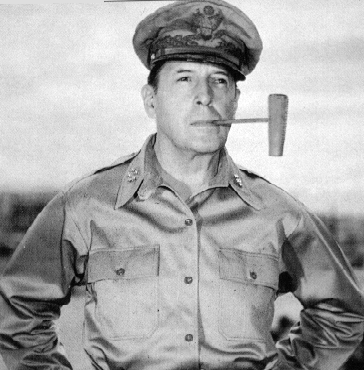
Before wrapping up, a quick example of just such a case in our nation’s history where a general won a battle but lost the war.  In Korean War, General Douglass MacArthur, hero of the Pacific in World War II, defeated the Soviet backed North and pushed them out of the South.  Had he stopped there, it would have been both a military and political victory.  But he did not stop there.  MacArthur drove his forces into the North, drawing too near to the Chinese border and prompting them to pour in their own troops, resulting in an ugly stalemate that settled little.  MacArthur exceeded the impetus of the attack in crossing the 38th Parallel and scared the Chinese into action (fearing an invasion of China by MacArthur).  He had won, accomplished the main political objectives of the United States and their allies but because of a lack of political oversight, that victory morphed into a stalemate at the very best. 

Politics dominate the world, everything else is reliant on politics to a certain degree.  Warfare and its conduct is no different.  Not only should war be overseen by politicians but very closely monitored.  Without close oversight, war can quickly get out of hand and exceed the bounds of the political objectives that the military set out to accomplish.  Sound strategy should be conceived with political goals in mind and carried out by the generals under the watchful eye of the politicians.    


  • Wilson, Andrew R. Masters of War:  History’s Greatest Strategic Thinkers. The Great Courses. Audio.